Friday, December 9, 2011

Oriental Rugs Oriental Carpets Designs

In the not very distant past, there were only two general rug designs, medallion and overall (floral) designs. Now, there are endless designs some of which have no clear definitions such as contemporary, transitional, or modern designs. Here I am posting some sample pictures from different types of Oriental and Persian carpet designs.
 Typical corner central medallion design from Kashan, Iran.
 Typical corner central medallion design from Kerman, Iran.
 Overall floral design from Nain, Iran with repeating motives.
Overall floral design from Kashan, Iran with repeating motives.
 Tribal Gabbeh design rug made with hand spun wool and natural dye from province of Fars, Iran with relaxed and open field design. Red comes from the root of madder with blue from indigo.
Tribal Gabbeh design rug made with hand spun wool and natural dye from province of Fars, Iran.
Animal combat design, antique early 20th century signed 12' x 16' Tabriz carpet from Iran.
Royal hunting design.
Royal hunting design from Kashan, Iran, semi-antique 5' 1" x 7' 2"
 Bokhara Turkmen Gul design.
Bokhara Turkmen Gul design.
Corner central medallion Heriz design from north west Iran. Although this is a sub-category of medallion design but because of its unique geometric design, it can be identified as Heriz design.
 One version of tree of life design from Kashan, Iran.
Multi-medallion design, Hamedan runner from a very small town in north west Iran, called Zagheh.
Multi-panel garden design Bakhtair Persian carpet from province of Isfahan, Iran.
Pictorial designs with human figures.

Boteh Paisley design.
 Prayer Mehrab niche design.

There are many more categories that I will try to add later to have a more competed coverage of carpet designs.

Dr. Khosrow Sobhe (Dr. Kay)
Certified Rug Specialist (CRS)
www.LosAngelesRugCleaning.com
www.RugIdea.com
Tel. 310-770-9085

Thursday, December 8, 2011

Hand Knotted Rugs Machine Made Area Rugs

You see a rug or you want to buy a rug and you do  not know if that is hand made or not. What do you do? Let me mention three characteristics of each group:

1- Take a look at the selvages or bindings at the sides. If the rug is hand made (hand knotted), the bindings or selvages are done by hand. It maybe thinner in one part and thicker on the other parts. There maybe some inconsistencies along the way. The selvages may not be perfectly straight as it is done by hand.If the rug is machine made, the selvages and bindings are done by machine. You may see the consistent and perfect stitches done by a machine. In this case, the selvages are straight.
 Area rug machine made rug. The binding is done by a machine. Stitches are visible.

Hand knotted rug. The selvages (bindings) is done by hand.

If a rug is machine made, fringes (tassels)are not part of the foundation and are prefabricated attached or sewn to the rug. This can be seen if you flip the rug and take a look at the back. If a rug is hand knotted, fringes are part of the foundation and are not sewn or attached to the body of the rug.
 Machine made rug with fringes sewn to the body of the rug.
Hand knotted rug. Fringes are the foundation and part of the rug.

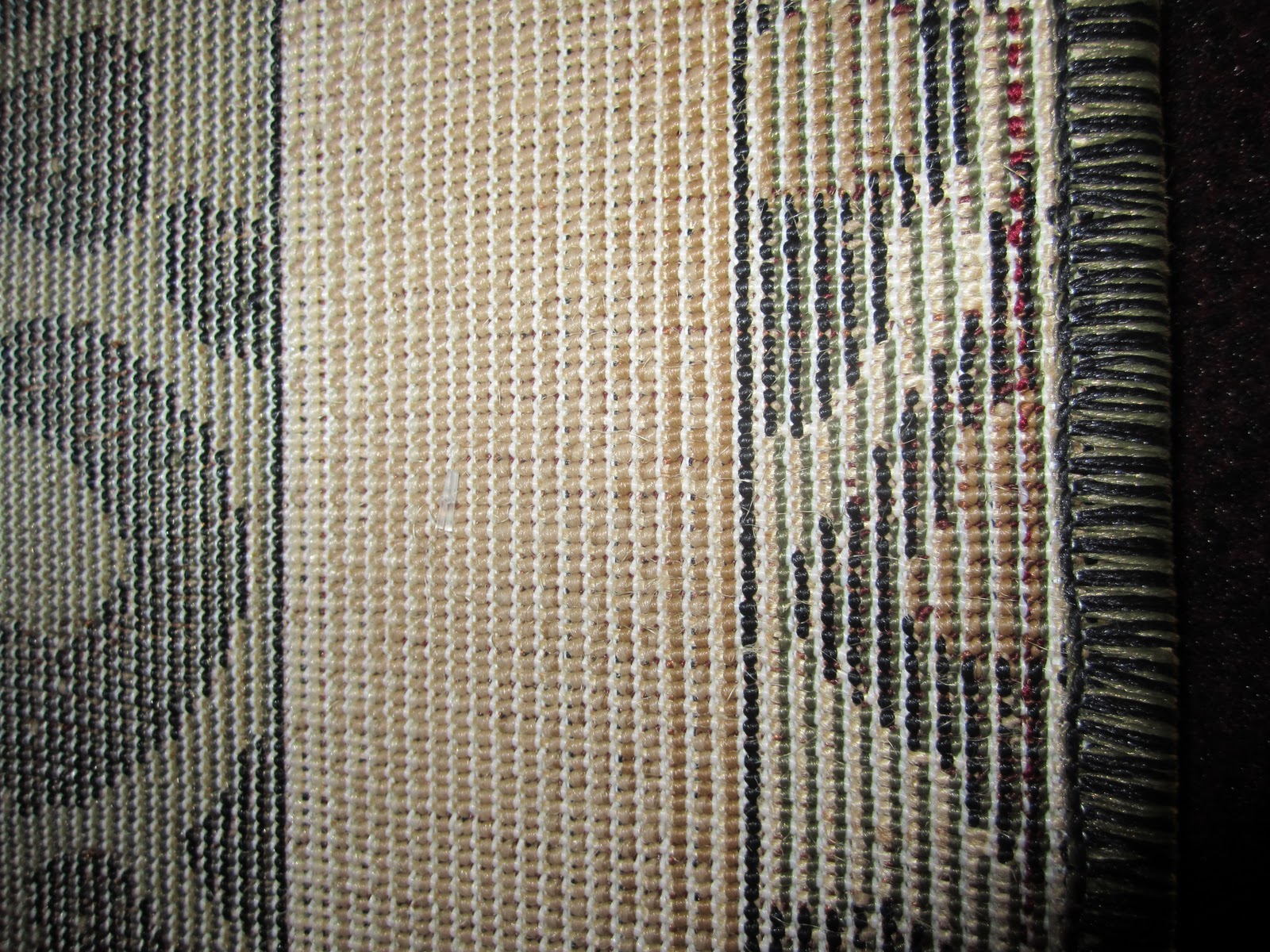
If a rug is machine made area rug, there are no knots in the back. You can not see the knots and cannot pull the knots out with a needle or sharp knife. If a rug is hand knotted, you can see the actual knots. Some of the knots maybe smaller and some bigger. You may see the inconsistencies. The rows of the knots are not perfectly straight.
 Machine made rug. You do not see actual knots.
Hand knotted rug. You can see the actual knots and the inconsistencies.
Dr. Khosrow Sobhe (Dr. Kay)
Certified Rug Specialist (CRS)
www.LosAngelesRugCleaning.com
www.RugIdea.com
Tel. 310-770-9085

Wednesday, December 7, 2011

Beautiful Antique Malayer Rug

Beautiful antique hand knotted Persian Malayer rug 3' 5" x 4' 9" pre-1900. This unique rug has symmetrical knots, cotton foundation and lamb's wool pile. It is single-wefted with floral design. The small town of Malayer is in the province of Hamedan in north west Iran with a good history of rug making. There is almost no rug production any more in this town. So this is a vanishing art. It is very rare to see a Malayer rug with this beautiful harvest gold color background and deep burgundy borders. The sale price of this piece of art is only $950.


Dr. Khosrow Sobhe (Dr. Kay)
Certified Rug Specialist (CRS)
www.LosAngelesRugCleaning.com
www.RugIdea.com
Tel. 310-770-9085

Monday, December 5, 2011

How We Keep Rugs From Curling

We iron the edges by using a damp cotton cloth and then sew leather strips by hand to the edges on the back of the rug. This will take care of the problem. Usually machine made area rugs and new hand knotted rugs do not have curling problem. Curling happens when the rugs are not used on the floor properly with a good rug pad under them. In some cases shrinking of the wefts may cause curling. Whatever the cause maybe, sewing leather strips to the edges would take care of the curling problems and rugs stay flat on the floors.


Dr. Khosrow Sobhe (Dr. Kay)
Certified Rug Specialist (CRS)
www.LosAngelesRugCleaning.com
www.RugIdea.com
Tel. 310-770-9085

Sunday, December 4, 2011

Rugmaster.blogspot.com


20,463 Visits
17,655 Unique Visitors
31,310 Page view
These are the statistics of my blog for the past 12 months. The visits for the previous year was 14,549. So this year, the number of visits has increased by 40% compared with the last year. 61% of the visitors came from the U.S., 7% from U.K. and 5% from Canada. That is exciting. It shows regardless of the slow rug market, the interest to read and learn about rugs is there. You just have to feed it. I sat up my blog in October 2007 and have had 770 posts so far. My goal for the blog is having richer contents with good, exclusive (my pictures not borrowed form the Internet) and relevant pictures. I will have 1,000 posts by the end of June 2012.

Being able to communicate with your readers from around the world and sharing your ideas and real rug stories feels so good. For me, the glass is always half full.


Dr. Khosrow Sobhe (Dr. Kay)
Certified Rug Specialist (CRS)
www.LosAngelesRugCleaning.com
www.RugIdea.com
Tel. 310-770-9085

Balouch Rugs

Balouch rugs are made mostly in the province of Khorassan in north east Iran. They are entry level rugs for those who want to start buying/collecting rugs. Balouch rugs have the following characteristics:
1- They are small and below the size of 5' x 8'. Some people refer to them as prayer rugs.
2- Tribal pieces with geometric designs and stylized animals and birds. There are some elements of Turkmen rug designs in them.
3- Limited color palettes with dark colors and corrosive brown dye.
4- Low knot density.
5- Affordable prices starting from a couple of hundred dollars.
6- Wool foundation in older pieces with goat black hair selvages and bindings on the sides.
7- Asymmetrical knots and single wefted.
8- Made on horizontal ground looms.
9- Soft handle and easily pliable.


Dr. Khosrow Sobhe (Dr. Kay)
Certified Rug Specialist (CRS)
www.LosAngelesRugCleaning.com
www.RugIdea.com
Tel. 310-770-9085

Friday, December 2, 2011

Securing Fringes at the End of Rugs


By using rugs and carpets on the floor and vacuuming them, tassels or fringes at the ends get damaged and unravel. This may lead to losing the design of the rug if the problem is not properly taken care of.  There may be several options in dealing with this problem. One is securing the fringes as seen on the above posted pictures above.

The second option is overcasting and we do this if fringes are too short and unraveling may damage the design. Below, I am posting pictures of an overcasting job for an antique Isfahan rug. The quality of the jobs posted here is very high that one may think these are done by machine. One of our repair masters who has been in rug  restoration for over 40 years, has done the securing and overcasting of these two rugs.


Dr. Khosrow Sobhe (Dr. Kay)
Certified Rug Specialist (CRS)
www.LosAngelesRugCleaning.com
www.RugIdea.com
Tel. 310-770-9085